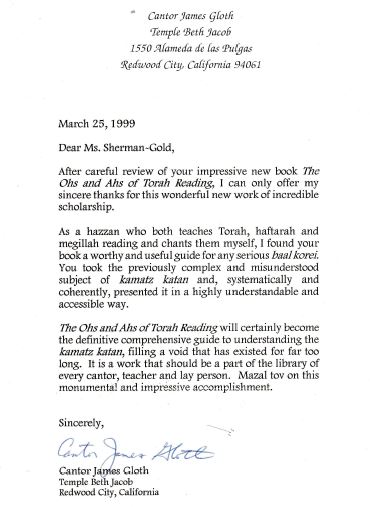
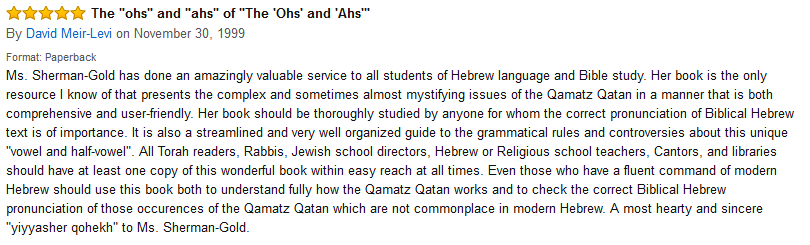
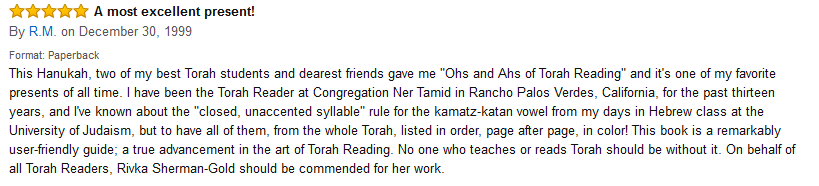
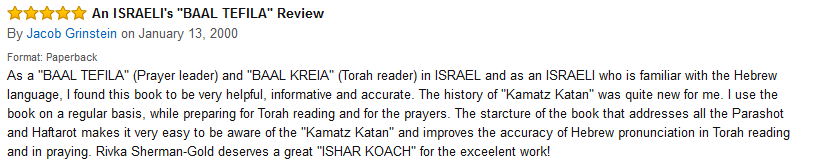
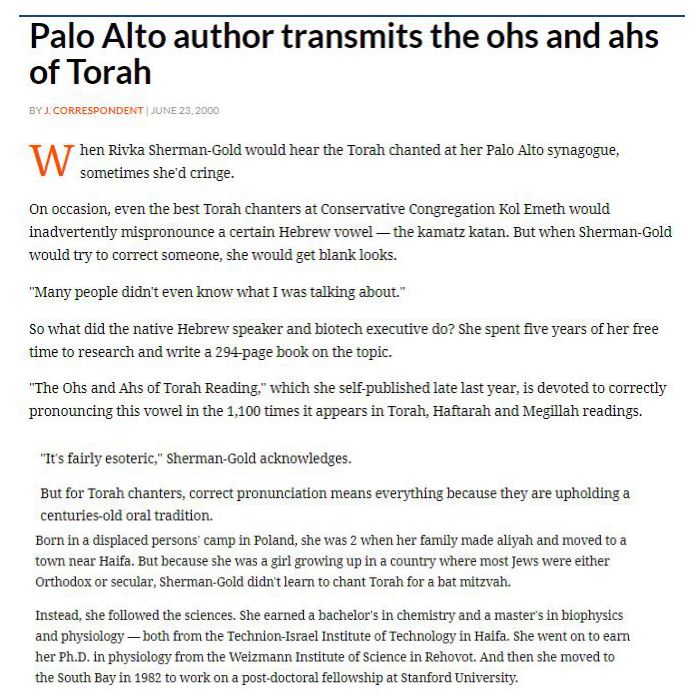
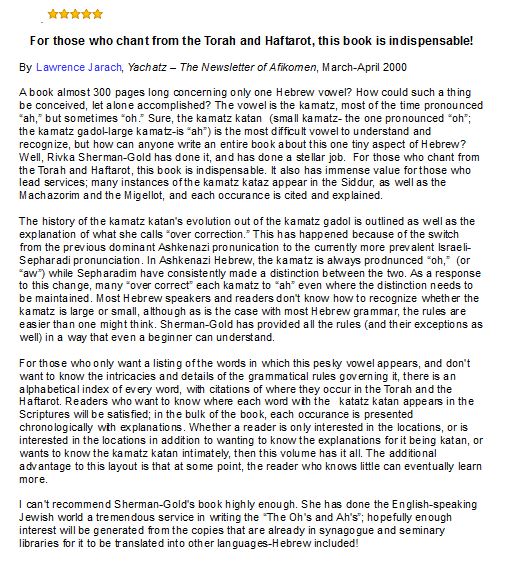
It is an absolute delight to hear of the republishing of Rivka Sherman-Gold’s masterful book, The Ohs and Ahs of Torah Reading. Sherman-Gold’s book was absolutely pioneering when first published over 25 years ago, and continues to withstand the test of time, remaining a one-of-a-kind resource for Torah readers and Hebrew enthusiasts the world over.
Back in 1998, this volume brought a new grammatical awareness to Torah readers, and a critical one at that, due to shifting pronunciation norms. During the many generations in which Ashkenazic Torah readers used distinct pronunciations for kamatz and patah, there was ostensibly no need to isolate instances of the kamatz katan. However, towards the end of the 20th century, it became more and more prevalent to find newly-trained Torah readers who were never trained in any such distinction especially regarding children coming of age in their synagogue. The lack of distinction between kamatz and patah itself is easily justifiable, with centuries of tradition behind it. But the distressing consequence of this conflation, for a community of Torah readers not previously familiar with such, was that cases of kamatz katan were similarly conflated with patah, creating numerous cases of blatantly erroneous readings.
At the time, printed תנ“כים and תיקון קוראים books alike utilized only a single symbol for kamatz and kamatz katan; indeed, the Unicode character for kamatz katan had not even been introduced, because the Unicode consortium had justifiably deemed it unnecessary for modern printing needs. Readers were thus faced with a new phenomenon that was not indicated in the printed texts in any way, and without any readily-available tools for its determination.
It was at this early juncture that Sherman-Gold produced her book, which not only isolates every single case of kamatz katan that a Torah reader must know about, but also explains the theory behind each case. Sherman-Gold differentiates between the different circumstances which lead to the formation of a kamatz katan, and then lucidly categorizes each case of kamatz katan in the Torah, color-coding all of the information in an eminently user-friendly volume.
Now, decades later, the situation has much improved. At the beginning of the 21st century, publishing houses slowly started to add indications of the kamatz katan character in their תיקון סופרים volumes and in their תנ“ך printings. On that backdrop, in 2005, the Unicode Consortium officially ratified a new Unicode point for the kamatz katan (U+05C7), and this allowed anyone with a word processor to easily print kamatz-katan marked texts. And yet, despite all of these advances, Sherman-Gold’s commonplace across almost all publishers, none of those publishers have taken the time to document why a given kamatz is katan or not; the actual decision- making process remains a lost art. And now that Torah readers almost universally are aware of this distinction, there is all the more need to understand the reasoning behind it, and to understand the forces at play; otherwise, the distinctions appear so very arbitrary and inconsistent, even to educated and experienced Torah readers. Thus, far from being obsoleted, Sherman-Gold’s unique book is of even more critical importance today.
If you are holding this book in your hand, then you are holding the key to understanding the multifaceted and multivalent mysteries of the kamatz katan, which Sherman-Gold has gifted to us.
Dr. Avi Shmidman Sr.
Lecturer Bar-Ilan University Department of Literature of the Jewish People